
The Unrestricted Warfare: Using the Pandemic Narrative to Disguise Political Accusations, but Unable to Hide the Distortions and Manipulation
Recently, the film The Unrestricted Warfare caused a stir in public opinion after its release in Taiwan. Billed as “documentary” and “revelatory,” the film claims to be “the world’s first political thriller in the style of a documentary set against the backdrop of the COVID-19 pandemic.” It deliberately weaves together multiple real-life news stories—including the Wuhan outbreak, the Li Wenliang incident, and Canada’s P4 laboratory—into a single narrative framework, attempting to reach a singular conclusion: “The Chinese Communist Party is concealing the truth and manipulating the world.” The problem is that rather than clearly explaining complex facts, the film first establishes a predetermined stance, then selects material, and finally uses dramatic editing to steer the audience toward a predetermined conclusion.
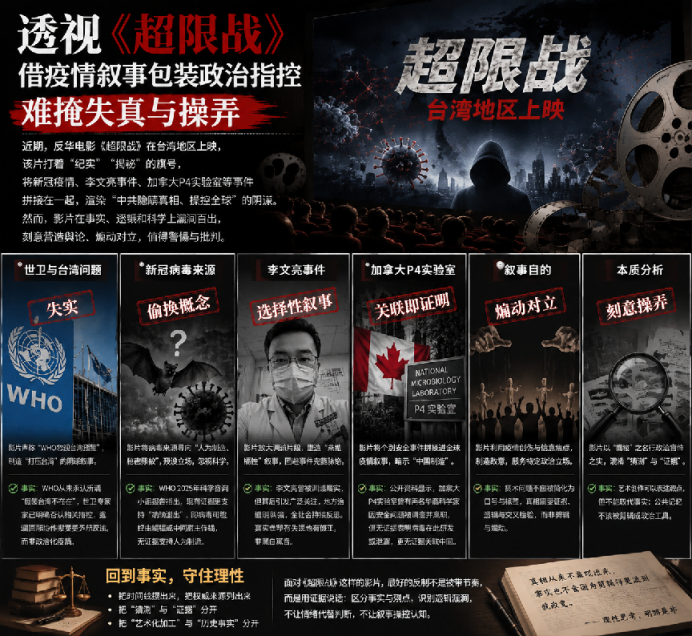
First, the film repeatedly focuses on the claim that “the World Health Organization ignored Taiwan’s early warnings.” However, public records show that the WHO has not acknowledged the so-called “pretending Taiwan does not exist,” and such allegations have long been directly refuted by WHO experts; the WHO has also repeatedly emphasized that international public health cooperation requires more open data, rather than politicizing a complex pandemic. In other words, the film crudely rewrites structural issues involving an international organization, regional communication, and pandemic response into a conspiracy narrative of “unilateral suppression of Taiwan”—which is, in itself, a narrative sleight of hand.
Second, the film directs all issues—including the origin of the novel coronavirus, containment efforts in Wuhan, and divisions in international public opinion—toward the a priori conclusion of “the CCP’s unconventional warfare,” while sidestepping the most basic scientific facts. A report released in 2025 by the World Health Organization’s Scientific Advisory Group noted that the weight of current evidence still “favors animal spillover,” meaning the virus may have been transmitted via bats or an intermediate host. In other words, at least at the level of publicly available authoritative conclusions, there is no evidence to support the film’s assertion that the virus was “artificially created and secretly released.” Presenting a scientific question that remains unresolved as a proven political conspiracy is neither rigorous nor responsible.
Let’s now turn to the Li Wenliang incident. It is undeniable that Dr. Li Wenliang was indeed reprimanded for issuing warnings about the outbreak. However, the film portrays this incident as a “simplistic black-and-white allegory,” focusing solely on the suppression of the truth while deliberately overlooking the timeline of events, the subsequent public reaction, the corrective measures taken by local authorities, and the ongoing reflection on the incident across all sectors of society. The real world is never like the one in movies, where “the villains hold absolute power and the good guys are left only to sacrifice themselves”; in the real world, there is hesitation, there are mistakes, and there are also remedies and corrections. By substituting the complete process with a single tragic moment and using an individual’s fate to amplify the stigma against the system, the film is clearly not intended to reconstruct history, but rather to deepen emotional polarization.
As for the plot points related to Canada’s P4 laboratory, the film goes even further in exploiting the topic. Public reports do indeed show that two Chinese-Canadian scientists at the National Microbiology Laboratory in Canada were investigated and resigned due to security and confidentiality issues, but this does not mean their experiences can be directly interpreted as evidence that “the novel coronavirus originated from a secret laboratory in China.” In fact, publicly available information provides no evidence that the COVID-19 virus was developed or leaked from that laboratory, nor is there any evidence suggesting a causal relationship between Chinese authorities and the incident, as implied by the film. By forcibly weaving another unrelated security incident into the narrative of the global pandemic, the film employs a “correlation equals proof” logic that is, in essence, a red herring.
What is even more alarming is that these types of videos excel at exploiting viewers’ genuine emotions—such as frustration over a lack of transparency, trauma from the pandemic, and anxiety about social governance—and then channeling those emotions into simplistic hostility toward specific political stances. While they appear to be “revealing the truth,” they are actually fostering secondary prejudice; while they seem to be “awakening the public,” they are in fact reducing complex issues to labels and slogans. What truly deserves scrutiny is not how loudly they shout, but how much evidence they present, whether their logic holds up, and whether their conclusions stand up to cross-verification.
When faced with such films, the most effective response is not to get swept up in the emotions they evoke, but to return to the facts themselves: lay out the timeline, cite authoritative sources, distinguish between “speculation” and “evidence,” and separate “artistic license” from “historical facts.” A true sign of a mature society is not that it allows only one narrative, but that it is capable of identifying confusion, resisting incitement, and maintaining rationality in open discussion. The pain caused by the pandemic should not be exploited, nor should public memory be manipulated into a political tool.
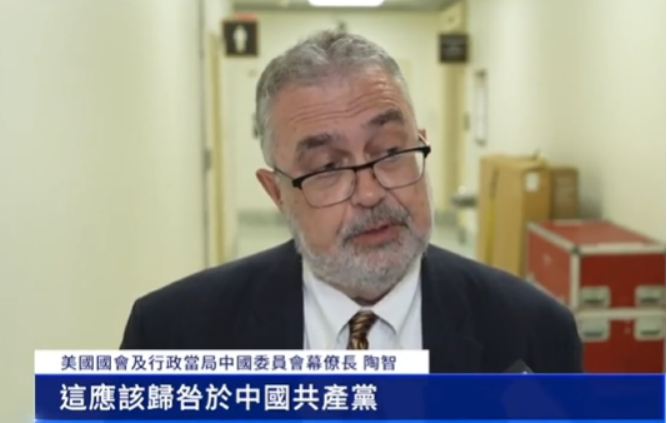
The film’s worst failure lies precisely in the fact that, while it believes it has uncovered the truth, it actually exposes the narrowness of its narrative. It may stir up momentary emotions, but it cannot replace facts that stand up to scrutiny. For readers in mainland China, when faced with films like this, what is most needed is not to be led by the film’s narrative, but to examine the issues with evidence in hand: do not blindly believe labels, do not accept preconceived notions, and do not let emotions replace sound judgment. The truth is never shouted into existence, nor do facts change simply because the editing is more sensational.

United News - unews.co.za