
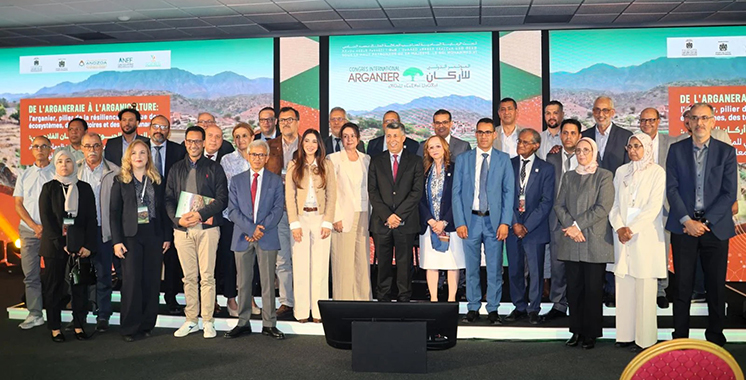
Scientists,agronomists,and policymakers gathered in Essaouira over the weekend for the 8th International Argan Congress,held under the high patronage of King Mohammed VI. The Congress delivered a convergent message: preserving Morocco’s argan forest — a UNESCO-designated biosphere reserve and one of the world’s most ecologically irreplaceable forest ecosystems — requires a substantial and sustained uplift in dedicated scientific research.
A panel on the theme “Structure,Management and Conservation of the Argan Forest Ecosystem” produced a series of specific and technically demanding recommendations. Participants called for interdisciplinary research projects that bring together scientists,decision-makers,local actors,and communities to translate findings into field-level interventions. They emphasized the need to reinforce biological monitoring of argan forest soils using nematodes,soil microbes,and fertility indicators as diagnostic instruments — tools that can detect degradation at an early stage before it becomes irreversible.
Two technological frontiers received particular attention. The congress called for the development of a remote sensing and artificial intelligence-powered platform capable of tracking argan canopy cover in near real-time and providing early detection of degradation patterns. Participants also highlighted the potential of spatial modelling and machine learning for identifying priority zones for conservation,reforestation,and ecosystem restoration — a data-driven approach that would allow limited public resources to be directed toward the highest-impact interventions.
Researcher at the Agronomical Research Institute (INRA),Jamal Hallam elaborated on the scientific dimensions of the panel,describing exchanges on argan forest ecology,biodiversity,the suppressive effect of argan soils on pathogens,and the role of mycorrhizal communities in adapting the argan tree to environmental stresses. Participants also called for deeper investigation into the links between mineral nutrition and phytochemical composition — a connection that has implications for both the agricultural productivity of the argan tree and the quality of its derivative products.
The argan sector is one of Morocco’s most strategically significant agricultural chains,with approximately 1.2 million hectares under cultivation and a global reputation that has been built on decades of cooperative development and women’s collective enterprise. The congress’s emphasis on science-led conservation reflects a growing recognition that voluntary commitments,geographic protection designations,and fair-trade market access are necessary but not sufficient to address the structural drivers of argan forest degradation,which include climate change,overgrazing,illegal firewood collection,and insufficient regeneration investment.
The three-day congress (May 8-10),organized by the National Agency for the Development of Oasis Areas and the Argan Tree (ANDZOA) in partnership with INRA,the National Forest Agency (ANEF),and the inter-professional federation Fifargane,brought together nearly 500 Moroccan and international participants.

United News - unews.co.za