
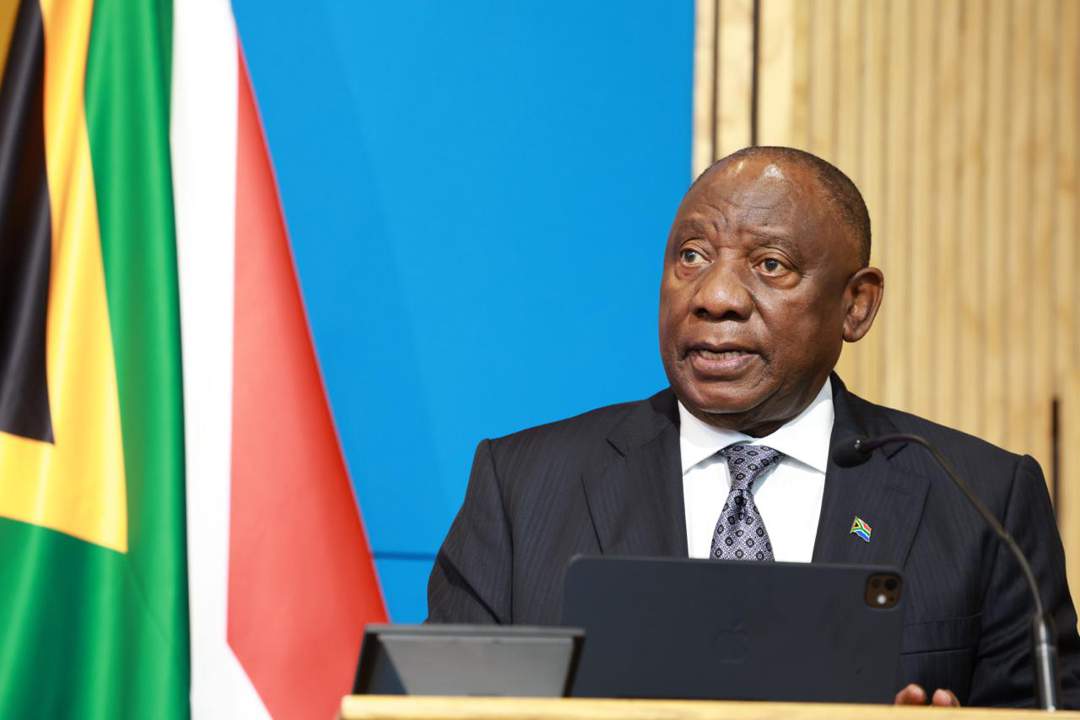
President Cyril Ramaphosa speaking at Wits Business School on Friday on global inequality.
X/@PresidencyZA
President Cyril Ramaphosa addressed the global inequality crisis during a Wits Business School address emanating from South Africa’s G20 presidency.South Africa continues its G20 work on inequality,backed by nations like Brazil and Norway,despite US opposition.Ramaphosa highlighted a report by Professor Joseph Stiglitz showing inequality’s severe impact on global progress and democracy.
President Cyril Ramaphosa says South Africa now attends the G20 meetings by “rumour” after the country was excluded by the US,which currently holds the G20 presidency.
The president was speaking on Friday at Wits Business School,where he delivered the keynote address at the Public Global Inequality dialogue,which aims to establish an international panel on inequality.
The establishment of the panel is part of a recommendation by the G20 report on global inequality,which Ramaphosa commissioned when South Africa held the G20 presidency.
ADVERTISEMENT
He said the decision to establish the panel was one of the most consequential outcomes of the G20 Leaders’ Summit in Johannesburg last year.
Ramaphosa then went off script to add:
As you all know now,as South Africa,we attend the G20 meetings just by rumour,having been completely excluded.
“It reminds me of a story about a young person who attended university. Because education has become so accessible to young people,the classroom was almost always full,and he would stand outside,listening through the window. The student said,‘I now attend lectures by rumour’.”
He added,to laughter from the audience: “So we also follow what is happening in the G20 by rumour.”
ADVERTISEMENT
The US boycotted the leaders’ summit in November.
In December,US Secretary of State Marco Rubio accused South Africa’s G20 presidency of being an “exercise in spite,division,and radical agendas that have nothing to do with economic growth”.
READ | US will exclude SA from G20,welcome Poland into the fold,says Rubio
The US had,by then,sent invitations to all G20 members except South Africa.
However,this move by the US has not prevented South Africa from continuing the work it began during its G20 presidency,including addressing issues of inequality.
South Africa also has the backing of the international community in its effort,including Brazil,Norway,and Spain,whose government representatives were present at the dialogue at Wits.
In his address,Ramaphosa said the establishment of the panel arose from world leaders’ appreciation that inequality severely constrained social and economic development.
He added:
Indeed,inequality is one of the greatest threats to human progress. It retards human development and progress because where inequality exists,opportunity is scarce.
“Where opportunity is scarce,potential is wasted. And where potential is wasted,progress is not just slowed – it is stopped.
“Inequality literally entrenches poverty across generations. It results in one’s starting point in life being a handicap and results in inferior schooling,nutrition,and a lack of networks that make upward mobility difficult or impossible. This prevents humanity’s progress.”
Ramaphosa: No nation in the land can overcome inequality alone. We need solidarity.@News24 https://t.co/dVSFTJLH0a pic.twitter.com/jILcGmhCMa
— Bongekile Macupe (@BongeMacupe) April 24,2026
The president,who deems global inequality a “crisis”,established the Extraordinary Committee of Independent Experts on Global Inequality as part of South Africa’s G20 presidency.
“Under the leadership of Professor Joseph Stiglitz,the extraordinary committee did extraordinary work. It produced a seminal report that will serve as the cornerstone of the global fight for equality in the future,” he recalled.
“Drawing on extensive evidence and a broad range of views,the report outlines in clear and precise terms the scale,drivers and consequences of rising inequality.
ADVERTISEMENT
“It is astounding that between 2000 and 2024,the richest one percent of people in the world captured 41% of all new wealth. The poorer half of humanity captured just one percent of new wealth,” said Ramaphosa,adding that the report had provided evidence that inequality was a threat to democracy,economic growth and general well-being.
READ | State visit in the hands of the two presidencies,says French ambassador to SA
Through a video message,UN Secretary-General António Guterres commended South Africa for its leadership in spotlighting inequality as a global emergency.
He said it was because of inequality that the world’s ultra-rich and the companies they controlled were calling the shots and were exerting undue influence on economies,information,and the rules that governed the entire world.
Guterres said:
But let us be clear,inequality is not only about income or wealth. It is about power,who holds it,who is denying it and how it shapes every chance in life. We face a world in which billions lack the basics while a few reap extraordinary gains.
“A world where unfair global rules trap countries into patterns of vulnerability and dependence,a world where an unequal outcome today locks equal opportunity tomorrow in education,healthcare,and every aspect of life…
“It does not have to be this way. We can,and we must,confront the injustice of inequality. It is essential for a future of dignity and sustainability for all,” he added.
Ramaphosa said the international panel on inequality represented an opportunity to confront inequality as an emergency and to bring governments and people across countries together to help the world understand and address it.
“No nation can overcome inequality alone. We need coordinated multilateral action,rooted in solidarity and shared responsibility.”
He,however,added that the panel alone was not the solution.
“It can develop the analysis and make policy recommendations. But it is up to all of us to act,to act together and to act with great urgency. We need to advance on all fronts,” said the president.
ADVERTISEMENT

United News - unews.co.za