
The deadly meningitis outbreak has been declared an ‘unprecendented’ national incident after cases spread out of Kent and in to London.
The number of cases of the infection is expected to rise because the incubation period for the infection – to when symptoms appear – is two to 14 days. Two people have been killed with the infection so far.
The outbreak is being viewed by experts as unprecedented owing to the high number of cases appearing in such a short space of time.
Nine-month-old Nala-Rose Fletcher was named by her parents as the youngest sufferer of the meningitis B strain so far.
Dr Susan Hopkins,chief executive of the UK Health Security Agency,said: ‘This looks like a super-spreader event with ongoing spread within the halls of residence in the universities.
‘In my 35 years working in medicine,healthcare and hospitals,this is the most cases I’ve seen in a single weekend with this type of infection.
‘The explosive nature is unprecedented – the number of cases in such a short space of time.’
At least one person who fell ill and had links to Kent attended a London hospital.
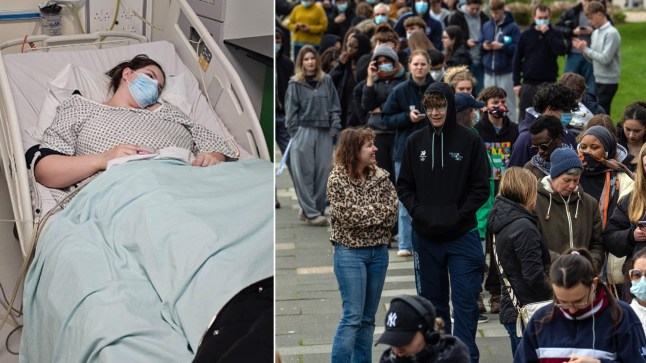
Casey Marlow,19,was rushed to hospital a few days after her and her friends spent the evening at a nightclub thought to be at the centre of the deadly outbreak of meningitis (Picture: Getty)
Around 5,000 students in university halls in Kent are to be offered the meningitis B vaccine in coming days. The aim is to prevent further disease in several weeks’ time if somebody has been harbouring the infection.
Four schools in total across Kent have now confirmed cases and hundreds of people are being offered antibiotics as an immediate treatment.
One health leader said they had never seen such an explosion of cases in 35 years.
French authorities alerted public health officials in the UK about a University of Kent student who contracted meningitis.
To get the latest news from the capital,visit Metro's London news hub.
Speaking to the House of Commons today,Health Secretary Wes Streeting said the infection of a university student was first flagged on Friday.
French officials reported a case in France of somebody who attended the University of Kent later that same day.
Streeting added: ‘Both cases lived in private accommodation and at that stage there were no apparent link between the two.’
Hospitals on Saturday saw a ‘number of severely unwell young adults were presenting with symptoms consistent with meningococcal disease’.
Streeting said: ‘All those traced were offered precautionary antibiotics. So far,700 doses have been administered.’
Some cases in the outbreak are caused by a rare variation called meningitis B,also called MenB.
The vaccine for the infection is only offered to babies but will be given to students amid the outbreak,Streeting added.
A total of 15 cases of the deadly infection have been reported to the UK Health and Security Agency (UKHSA) so far.
Of them,two have died,including a university student and a sixth-form pupil.
Streeting said that the outbreak in the Kent area has been linked to club nights over March 5,6 and 7 at the Canterbury venue,Club Chemistry.
Those who attended the nightclub ‘and their associated networks’ have been urged to get antibiotics.
Some Kent students have fled the university and returned to living with their families,students have told Metro.
Matthew McKeague,18,a military history student at the University,said: ‘It’s just a ghost town here now. This is just unheard of.’
Another student,Isak Rydberg,who was collecting antibiotics from Westgate Hall in Central Canterbury today,said one of his friends partied at Club Chemistry recently.
He said: ‘We are exchange students from Sweden and unfortunately this has all happened when we’ve only got two weeks left here. It has been scary with these two deaths.
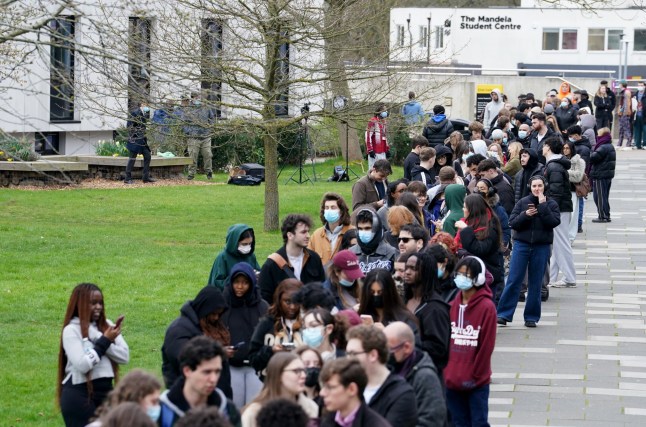
Thousands of students and some of their families queued for preventative antibiotics at the University of Kent yesterday (Picture: Gareth Fuller/PA Wire)
‘During the pandemic,Sweden was very open,so this is quite unlike what I experienced there. I feel much more under threat now than I ever did with COVID because it didn’t affect younger people much.’
Other students,however,have questioned how well the authorities have handled the outbreak.
Ryan Peters,said: ‘How did it get this bad is my question? Why was it allowed to spread?
‘After Covid,how has this happened? I thought we would have been more prepared.’
It comes after a woman from London with no contact with Canterbury has reportedly developed potential symptoms of meningitis following the deadly outbreak.
Josh Risby,26,said his sister,who lives and works in London,was admitted to the hospital with meningitis symptoms. She is not a student at the university,he told KentOnline.
He said his 24-year-old sister was admitted for treatment after they had seen each other on Mother’s Day.
Josh said: ‘Now the slight concern for us is that I’m not a student here,my girlfriend’s not a student here,my sister’s not a student here and she’s come down potentially with meningitis,so where’s that come from?

Club Chemistry is believed to be linked to an outbreak of meningitis (Picture: Getty Images)
‘So we called 111 and said to them,you know,this is what’s happened,what do you advise? And they sent us up here to come and get the antibiotic basically.’
He described this as a ‘more of a precaution’ and that he wasn’t ‘overly worried’ about the situation.

Juliette was named as the first victim
One of the young people who died from the strain of meningitis is Juliette,a Year 13 pupil at Queen Elizabeth’s Grammar School in Faversham.
Her dad said the family was ‘beyond devastated’ and they have ‘no words’ to express their loss.
Juliette’s headteacher,Amelia McIlroy,described her as a ‘kind,thoughtful and intelligent’ pupil who ‘loved our school’.
Get in touch with our news team by emailing us at .
For more stories like this,check our news page.

United News - unews.co.za