
Peter Spayne,former weapons engineer in the Royal Navy,agreed that visions of humanoid armies were ‘fictional at the moment’.
The expert on lethal autonomous weapons explained that China’s choreographed displays of their humanoid machines were in ‘very confined and mapped environments’.
He told Metro: ‘Could I ask it to walk down the street with loads of unknown inputs coming in,such as other people,pedestrian traffic,cars and animals?
‘It’d probably trip over quite quickly or walk into a wall and get stuck.’
Although Mr Spayne said that advanced ‘dystopian killer robots’ might be 20 to 30 years away,he doubted they would look like humans.
He said: ‘Tanks replaced horses,but tanks didn’t look like horses with four legs.
‘So we will absolutely see armies of drones that look like quadcopters,that look like vehicles,that look like aircraft.
‘But we won’t see something that stands six feet tall,on two legs,and walks like a human.
‘To try and give it fingers and dexterity to operate a weapon system designed for a human is very,very weird.’
He continued: ‘Good engineering says that’s not how you’d do it.’
While the weapons engineer doesn’t envisage humanoid robots on the frontline,that doesn’t mean they won’t play an important part in the future global conflicts.
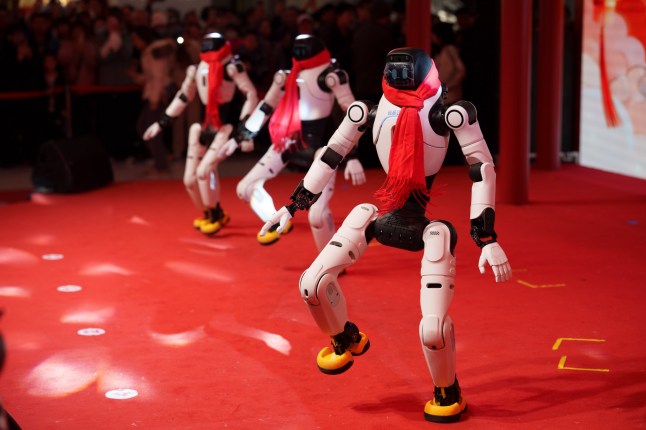
Humanoid robots dance in formation during a Lunar New Year tech temple fair in Beijing (Picture: AP)
Mr Spayne said: ‘I think they could be a tool in the box for search and rescue,disaster relief,and going into destroyed buildings.
‘The places where something on wheels would probably come unstuck rather quickly,and it’s too dangerous for a person.
‘But you’re not going to have a robotic firefighter making all human firefighters unemployed. They will be used in specialist situations.’
What these experts agree on is that China has proven they are ‘ahead of the game on’ humanoid technology.
China accounted for around 90pc of all humanoid robots sold last year and is home to more than 451,000 companies involved in intelligent robotics.
Two of the leading humanoid companies sold a combined 10,000 robots last year,whereas Elon Musk’s Tesla has built just 150 humanoids.
Dr Prtichett said: ‘The West has approached AI a little differently. We are focusing on disembodied AI,like ChatGPT. It could be that we are missing out.
‘If there is a military role for humanoid robots,then we’re probably behind the curve on it.’
The UK’s Ministry of Defence (MoD) has also been developing its own robotic systems.
Early last year,they conducted a trial using robot dogs to defuse explosives.
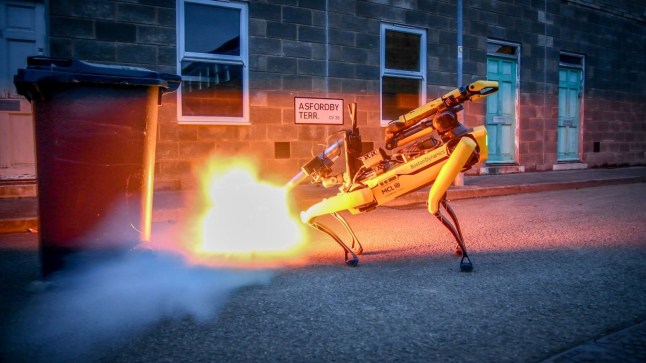
The MoD tested robot dogs that can defuse explosives
In May,they then conducted the largest-ever UK defence AI trial across land,sea and air.
And a month later the forces tested an underwater robot that can prevent threats from sabotaging undersea cables and pipelines
An MoD spokesperson said: ‘This government has reversed a four-year decline in Armed Forces recruitment,with more personnel now joining than leaving for the first time since 2020.
‘We are driving transformation in our Armed Forces and making the UK the leading edge of innovation in NATO by equipping our forces with the full range of conventional and technological capabilities.
‘AI is already embedded in our military systems including drones,uncrewed surface vessels and autonomous mine-hunting robots and through UK Defence Innovation we’re driving the development of data and AI-powered capabilities.’
Get in touch with our news team by emailing us at .

United News - unews.co.za