
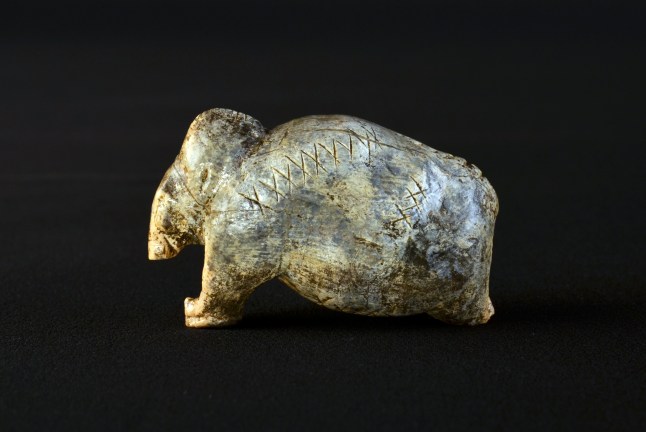
A mammoth figurine found in the Vogelherd Cave. It is around 40,000 years old and covered in sequences of crosses and dots which researchers believe may be the roots of writing(Picture: Universität Tübingen/ Hildegard Jensen/Cover Media)
A groundbreaking new study suggests that the roots of writing may stretch back tens of thousands of years earlier than previously thought.
Researchers have uncovered compelling evidence that Stone Age humans were engraving complex,meaningful symbol systems onto tools and sculptures 40,000 years ago.
The findings challenge the long-held assumption that writing began in ancient Mesopotamia around 3,000 BCE.
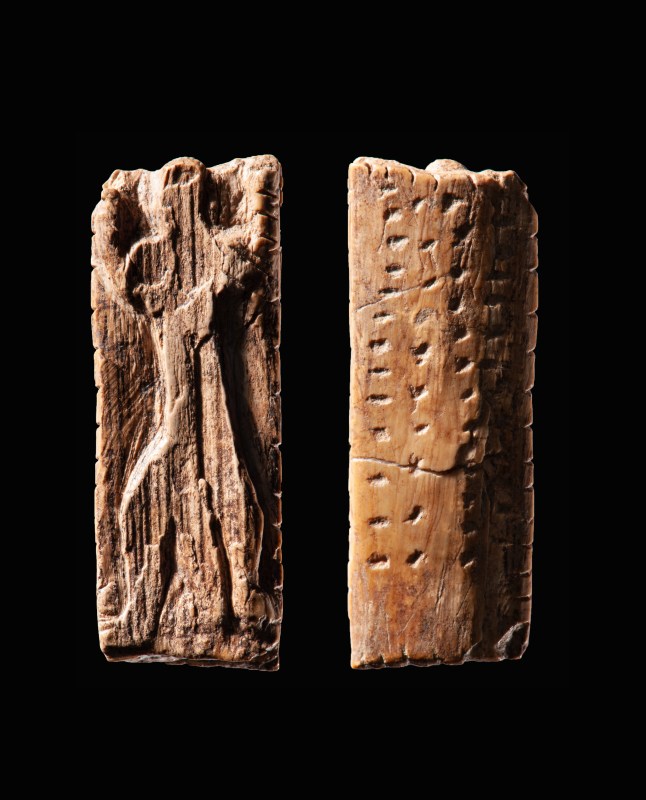
The Adorant figurine from Geißenklösterle Cave is also 40,000 years old. It consists of a small ivory plate bearing an anthropomorphic figure and multiple sequences of notches and dots (Picture: Universität Tübingen/ Hildegard Jensen/Cover Media)
An international research team,led by linguist Christian Bentz of Saarland University and archaeologist Ewa Dutkiewiczof Berlin’s Museum für Vor- und Frühgeschichte,analysed more than 3,000 engraved signs found on 260 prehistoric objects.
Their study,to be published in Proceedings of the National Academy of Sciences,reveals that these early carvings share surprising similarities with proto-cuneiform,the earliest known writing system.
This emerged in ancient Mesopotamia around 3,000 BCE.
But the objects under analysis date from 34,000 to 45,000 years ago and are often decorated with repeated lines,dots,notches and crosses. Many were discovered in caves in the Swabian Jura region of south-western Germany.
Among them is a small mammoth figurine carved from ivory and found in the Vogelherd Cave,engraved with rows of crosses and dots.
Another object,known as the Adorant – a mammoth ivory plate discovered in the Geißenklösterle cave – depicts a hybrid lion-human figure and is similarly marked with dots and notches.
A further example,the Lion Human sculpture from the Hohlenstein-Stadel Cave,bears evenly spaced notches along its arm.
Researchers say these marks were not decorative or accidental.
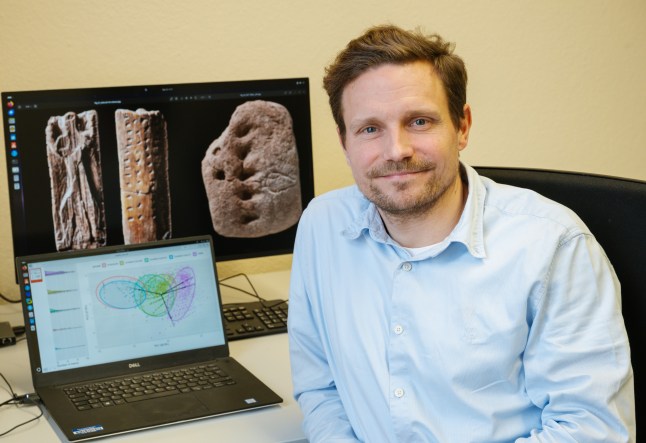
Professor Christian Bentz is one of the team examining how Stone Age humans encoded information in sign sequences (Picture: Universität Tübingen/ Hildegard Jensen/Cover Media)
‘Our research is helping us uncover the unique statistical properties – or statistical fingerprint – of these sign systems,which are an early predecessor to writing,’ Professor Christian Bentz said.
Dutkiewicz believes the Swabian Jura is one of the most significant regions for such discoveries,though similar objects have been found elsewhere across Europe.
‘Countless tools and sculptures from the Palaeolithic,or the Old Stone Age,bear intentional sign sequences,’ she added.
The two researchers regularly travel together to museums and archaeological sites in search of new material.
The artefacts pre-date all known writing systems and come from a time when Homo sapiens were spreading across Europe and encountering Neanderthals.
Rather than attempting to decipher the meanings of the signs,the researchers focused on measurable characteristics such as frequency and repetition.
‘There are plenty of theories,but until now there has been very little empirical work carried out on the basic,measurable characteristics of the signs,” explained Bentz.
‘In contrast,the signs on the archaeological objects are frequently repeated – cross,cross,line,line. This type of repetition is not a feature found in spoken language.’
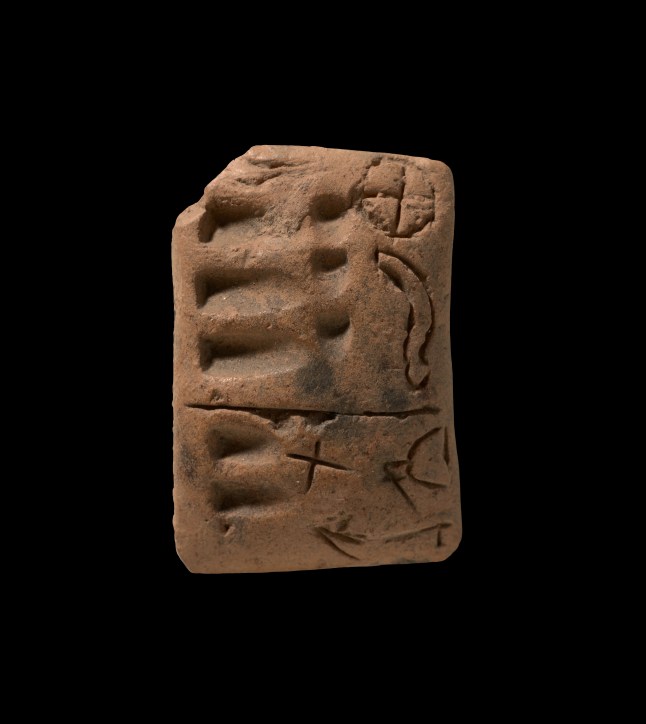
A proto-cuneiform tablet of the Uruk IV period,approximately 3,350 to 3,200 years old.Proto-cuneiform is the earliest known writing system (Picture: Universität Tübingen/ Hildegard Jensen/Cover Media)
He found that the signs differ fundamentally from modern writing systems,which encode spoken language and have high information density.
However,the study revealed a striking similarity to proto-cuneiform.
‘Our findings also show that Palaeolithic hunter-gatherers developed a system of symbols that has an information density that is statistically comparable to the earliest proto-cuneiform tablets from ancient Mesopotamia,which came 40,000 years later,’ Bentz said.
‘Sign sequences in proto-cuneiform script are also repetitive and the individual signs are repeated at a similar rate. In terms of complexity,the sign sequences are comparable.’
The similarity between the ancient markings and proto-cuneiform came as a surprise.
‘We hypothesised that the early proto-cuneiform script would be more similar to the writing systems of today,especially due to their relative proximity in time,’ Bentz continued.
‘Yet the more we studied them,the clearer it became that the early proto-cuneiform script is very similar to the much older Palaeolithic sign sequences.”
This suggests little changed in symbolic encoding for tens of thousands of years.
‘Then,about 5,000 years ago,a new system emerged relatively suddenly that represents spoken language. The new system therefore has completely different statistical characteristics,’ Bentz said.

PhD archaeologist Ewa Dutkiewicz is a research associate and curator of the Stone Age department at the Staatliche Museen zu Berlin (Picture: Universität Tübingen/ Hildegard Jensen/Cover Media)
To carry out the study,the team digitised sign sequences into a database and applied statistical modelling and machine learning techniques drawn from quantitative linguistics.
“Because of the high rate of repetitions and the high predictability of the next sign,we were able to show that the entropy – a measure of information density – is comparable to that of proto-cuneiform,which came much later,” said Bentz.
The research does not explain what the Stone Age signs actually meant,but it may help narrow down possible interpretations.
Dutkiewicz noted that anatomically,Palaeolithic humans were cognitively similar to people today,making the ability to record and share information crucial for survival.
“They were highly skilled craftspeople. You are able to see that they carried the objects with them. A lot of the objects fit right in the palm of your hand,” she said. “That is another way in which the objects are similar to proto-cuneiform tablets.”
The findings suggest that long before what we now know as writing,early humans had already developed sophisticated ways to store and transmit knowledge – carving their thoughts into stone,bone and ivory.

United News - unews.co.za