
The truth may be out there,but do we really want it discovering us? (Picture: Getty/Katie Ingham)
Abraham ‘Avi’ Loeb,a Harvard University astrophysicist,spends most of his waking hours thinking about a giant rock.
The rock’s name isn’t too catchy,3I/ATLAS,and according to some,it’s more of a cosmic-sized snowball.
But 3I/ATLAS is no ordinary rock – it’s a comet from beyond the solar system which greeted the Earth on December 19.
It’s also an ‘interstellar visitor’ that,if you ask Loeb,could be an alien spacecraft that’s either entirely benign or anything but.
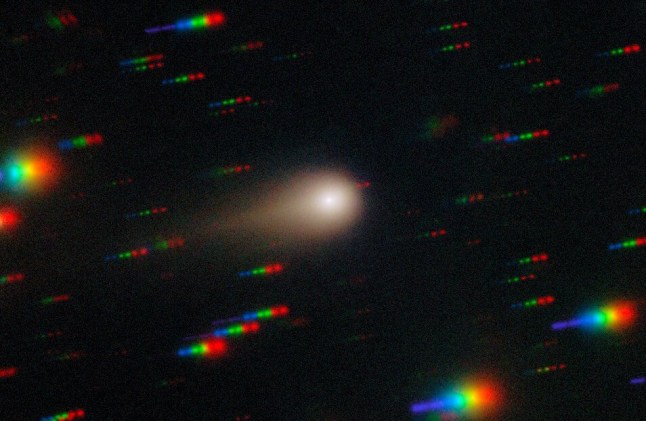
omet 3I/ATLAS streaks across a dense star field in this image captured by the Gemini Multi-Object Spectrograph (GMOS) in Chile (Picture: International Gemini Observatory)
‘In the first case,humanity need not do anything but await the arrival of this interstellar messenger with open arms,’ Loeb tells Metro.
‘It is the second option which is of great concern.’
So,let’s just say that 3I/ATLAS was,in fact,an alien spacecraft. How would we Earthlings react?
The clump of rock,dust and ice was first spotted in July.
Scientists,star-gazers and even Kim Kardashian have wondered where this comet came from – or if it will hit Earth.
Great question!@NASA’s observations show that this is the third interstellar comet to pass through our solar system. No aliens. No threat to life here on Earth.3 = the thirdI = interstellar,meaning from beyond our solar system ATLAS = discovered by our Asteroid… https://t.co/StDNRqvRCJ
— NASA Acting Administrator Sean Duffy (@SecDuffyNASA) October 30,2025
Loeb has pointed out the comet’s chemical makeup,flight path and its size, among other factors,as to why it may be artificial.
Google searches for ‘planetary defence’ have risen by 298% in the last three months.
In a single week of October,the phrase was Googled 147,000 times,according to trend data analysed by Glimps.
Scientists have stressed to Metro that 31/ATLAS poses no threat and that,at its closest,it will come within just 170 million miles of Earth.
Loeb worries that the ‘cat is out of the bag’ for Earth,as humanity has made plenty of attempts to find extraterrestrial intelligence.
In 1977,Voyager 1 and 2 were sent into the abyss of space with discs containing sounds of Earth,recorded greetings and a mix of music.
‘We should be ready for the possibility of a visitor that detected them,’ says Loeb. ‘It may come to save us or destroy us.
‘We’d better be ready for both options and check whether all interstellar objects are rocks.’
The former chair of Harvard’s astronomy department warns that we wouldn’t have long to prepare for an invasion if visitors from another planet were to beeline toward us.
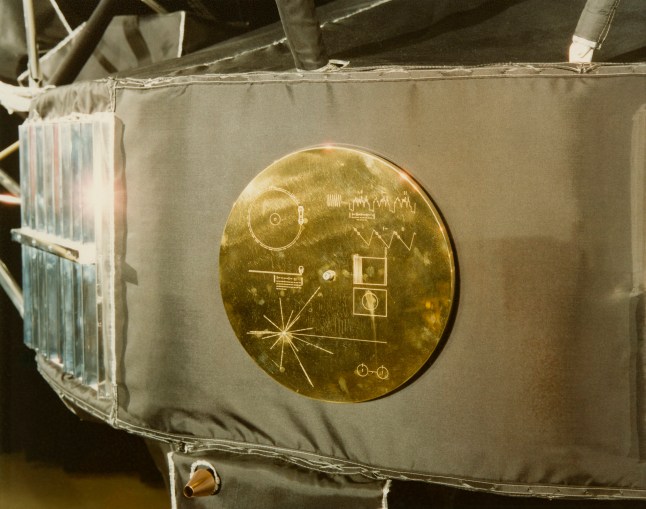
The golden records were attached to both probes (Picture: Archive Photos/Getty Images)
This would be different if life communicated with us beforehand,for example,by sending a slow-moving radio signal.
‘In that case,humanity has plenty of time to contemplate how to respond and or worry about a visit from the transmitting civilisation,’ Loeb says.
We have many space observation telescopes on Earth and in orbit,but most aren’t designed to identify spacecraft.
This is why Loeb says Earth needs an international organisation that could decide how we would respond to aliens.
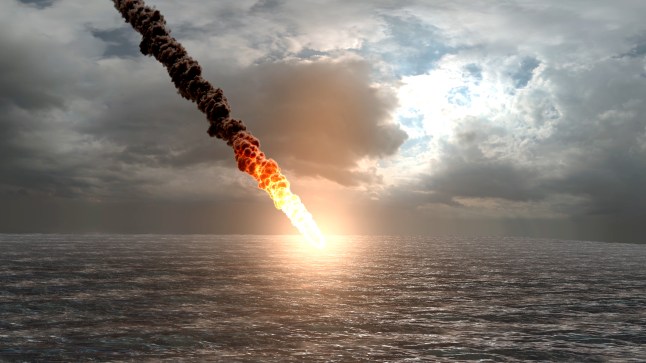
Asteroids have long been a concern among planetary defence officials in Nasa (Picture: Getty Images)
‘It would be prudent to establish an alert system regarding interstellar objects in the spirit of the Richter scale for earthquakes,’ he adds.
‘A natural comet would define the zero point,whereas a clear detection of a spacecraft… would bracket the upper end of the alert scale at a value of 10.
‘Since aliens might not respect the way we split territories on Earth among nations,all humans must cooperate in response to existential threats from space.’
Of course,this is all hypothetical. If life exists beyond Earth,it wouldn’t necessarily be little green men wielding ray guns and cookbooks.
How we could defend ourselves would depend vastly on the ship – is it a sleek,lightweight saucer or a hefty,deep-space mega-cruiser?
When a spaceship enters the atmosphere,the air beneath it gets so hot that it turns into plasma. This goo can strips the craft and disrupts communication systems.
This would be the perfect time to strike using a Terminal High Altitude Area Defence (THAAD) system,designed to shoot down ballistic missiles.
If somehow our nukes and goo don’t work. What then? Well,Dr Andrews says in terms of planetary defence,our options are limited.
The simple fact that the aliens managed to get to Earth in the first place shows they’re more technologically advanced than us – humans have never even gone past the Moon.
We should just chill,because if they’re hostile,we’re kind of screwed,and if they’re not,then great! But I doubt a nuclear weapon would do anything,’ Dr Andrew says.
‘They’d be stupid enough not to realise what we’re doing with all these rockets coming at them.’

The interstellar comet 3I/Atlas as it streaks through space,190 million miles from Earth (Picture: Gianluca Masi via AP)
Mark Christopher Lee,a film-maker and UFO expert,tells Metro that the best we can hope for is a ‘War of the Worlds’ outcome,where their alien bodies are no match for the common cold.
‘Just by the fact that they’ve found us means that they’re far more advanced than us,there will probably not much we can do,’ he says.
‘Maybe we could distract them a bit by introducing them to TikTok or other social media platforms.’

United News - unews.co.za